01
Awareness
Know what is at home
Ambient tracking of groceries and pantry provisions through spoken commands, without demanding manual barcode scanning or receipt photography.
→ Spoken inventory capture
A Voice-First Household Intelligence System
Save is a voice-first household intelligence system designed to help people manage food at home, reduce unnecessary waste, and turn daily domestic routines into effortless environmental awareness.

Authentic Splash UI • Release Candidate (Build 24)
Save replaces tedious manual logging with an ambient, responsive loop that quietly assists daily household decisions.
Ambient tracking of groceries and pantry provisions through spoken commands, without demanding manual barcode scanning or receipt photography.
Surfaces items that require timely consumption first, transforming chaotic refrigerator shelves into clear, prioritized daily clarity.
The shopping list is actively connected to what is already stored at home, preventing duplicate purchases and unnecessary expense before checkout.
Transparent visibility into household food utilization, connecting real home habits with grounded, scientific environmental metrics.
Food, shopping, waste and household knowledge — connected through one natural, unified interface.
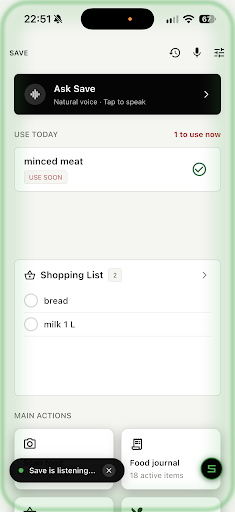
"Not another database to fill. An ambient intelligence that listens and clarifies."
Unlike conventional grocery apps or caloric diaries that demand tedious manual barcode logging, Save removes friction through natural spoken commands, intelligent urgency tracking, and household-level memory.
Items surface dynamically by spoilage risk ("Use today", "Use soon") rather than alphabetical chaos.
The shopping list is directly informed by active pantry inventory to help prevent duplicate purchases at the store.
Learns your household's actual storage habits on-device without sending personal data to external model trainers.
Relies on established European environmental databases (ADEME AGRIBALYSE 3.1) for transparent lifecycle calculations.
Save is designed around natural interaction. Instead of navigating every household task manually, people talk to Save and turn everyday intentions into structured household actions.
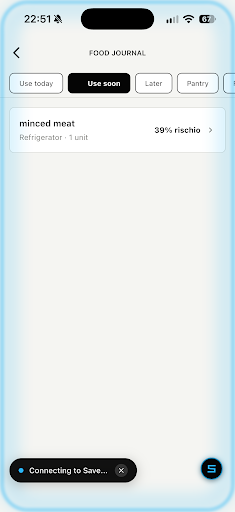
"Connecting to Save..."
Upon invocation, a quiet cyan glow sweeps the phone boundary, establishing an open voice socket without blocking user view.
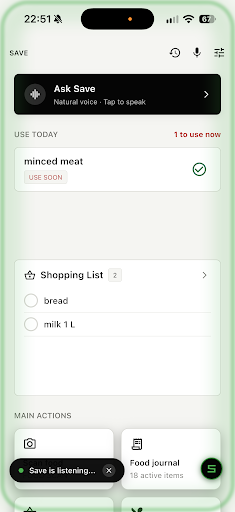
"Save is listening..."
Transitioning cleanly to natural emerald green, the perimeter communicates presence. Hands-free logging while cooking or unpacking groceries.
Most household food waste happens not from indifference, but from invisibility. Food gets stored away, forgotten in refrigerator drawers, and noticed only when it has spoiled.
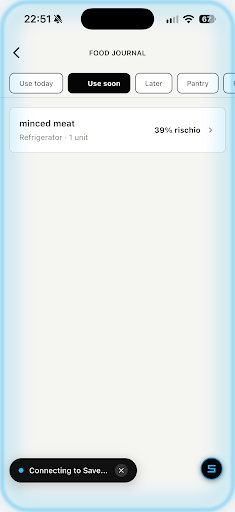
Save replaces static item lists with dynamic urgency categorization: Use today, Use soon, Later, and Pantry.
Inside the application, each logged item generates an individual product risk indicator based on storage temperature, date logged, and item sensitivity. It is a domestic prompt to consume high-risk ingredients on time — not a company-wide performance metric.
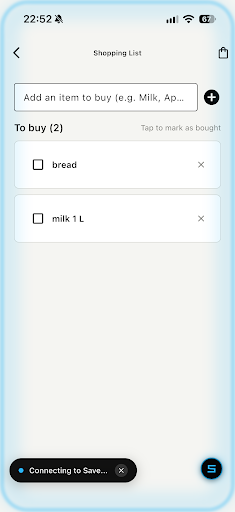
Standard shopping lists are disconnected note pads. They don't know what is already in your pantry or refrigerator, leading to over-purchasing and duplications.
Save connects purchase intentions directly with inventory reality. When you add items or ask Save to compile your list, it checks existing stocks to alert you if something is already available at home.
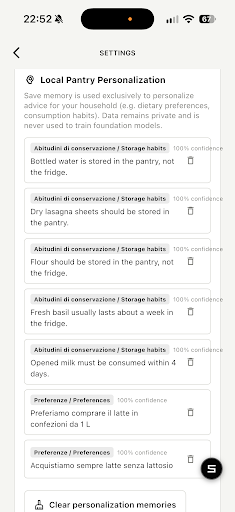
Every home stores food differently. In Italy, bottled water stays in the pantry, lasagna sheets have specific humidity requirements, and milk preferences are strictly personal.
Save quietly observes and formalizes storage habits with explicit confidence scores — while guaranteeing complete privacy:
"Save memory is used exclusively to personalize advice for your household. Data remains private and is never used to train foundation models."
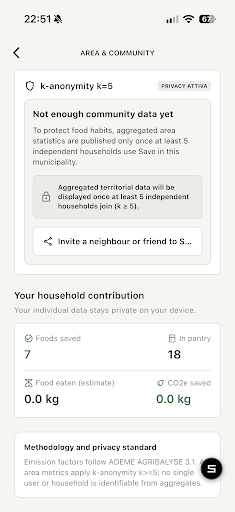
Your data stays on your device. Community insight is only shared when enough neighbors participate together (k-anonymity k≥5), ensuring no individual household's habits can ever be singled out.
Aggregated area statistics are never published until at least 5 independent households participate within a given municipality. No individual habit or single household is ever identifiable from territorial data.
As visibly indicated in our live interface: "Not enough community data yet". We refuse to fabricate artificial community statistics or fake municipal traction — this transparency reflects our rigorous privacy engineering.
Where implemented, environmental calculations reference verified scientific emission factors rather than arbitrary assumptions, translating actual food eaten or saved into estimated averted emissions.
Waste management, sorting rules, and municipal collection calendars change from valley to valley, commune to commune.
Save was conceived in Piemonte, Italy. In Northern Italy, as across many European regions, each municipality enforces exact separation calendars: organic matter, transparent dedicated plastic sacks, specific weekly rotation bins.
Rather than offering generic global tips, Save is engineered to absorb regional municipal parameters (e.g., SETA S.p.A. ecocalendars in Bacino 16) so recommendations correspond to the physical reality of the user's doorstep.
"An environmental tool is only as good as its contextual accuracy. We do not ask people to change their lives; we align technology with where they actually live."
Note: Save is developed independently in Piemonte and references municipal calendars for functional utility without implying official endorsement.
Civic collection rules, fraction types, and door-to-door sorting schedules are integrated on-device so daily habits map cleanly to local collection reality.
Built independently in Northern Italy with full architectural independence, prioritizing localized relevance over one-size-fits-all generic environmental prompts.
Every feature in Save is designed with one unified objective: helping families keep track of what they already have, surface items needing prompt consumption, and reduce unnecessary spending and spoilage through natural awareness.
Hands-free natural language capture transforms spoken groceries into categorized items, expiry estimates, and automatic storage groupings.
Integrated duplicate detection flags items already present in refrigerator or pantry shelves before you buy them again.
Household habits and storage rules stay strictly on your device. Personal memory data is never transferred to foundation model trainers.
Calibrated directly to municipal collection rules and sorting calendars to provide actionable, doorstep-accurate waste guidance.
Save is not a conceptual slide deck. It is a functional Release Candidate tested on real physical smartphones.
Functional mobile architecture implementing native audio processing, live socket connections, and reactive local storage.
Tested on real hardware devices across Apple iOS and Android environments, validating microphone latency and battery performance.
Hands-free conversational parsing capable of extracting multi-item pantry entries, volume measurements, and shelf destinations.
Local pantry personalization adapting to household-specific dietary choices without exporting data to public foundational training sets.
Calculations reference established European environmental lifecycle data to map household food avoidance directly to CO₂e estimates.
Independently engineered in Piemonte, Italy, by Anatol Radzko, with full architectural autonomy and focus on long-term user trust.
The foundation is verified. The next evolutionary phases expand Save from an attentive personal tool into an ambient household operating intelligence.
Anticipating depletion curves before items run out, offering intelligent replenishment cycles based on seasonal usage.
A permanent, low-power magnetic counter device designed specifically for ambient voice capture and cooking support.
Privacy-preserving territorial dashboards allowing city councils to calibrate organic collection routes to real waste trends.
Lightweight Matter/Thread protocols linking smart refrigerators and smart pantries to auto-verify door state and internal humidity.
Save is looking for the right partners to complete development, validate the product and bring it into real households.